




"There is no mercy in a backyard, there is no good try, there is only success or failure."
Laz
Set against the spectacular backdrop of Les Landes, on Jersey's rugged north-west coast, the Last Crapaud Crawling Backyard Ultra offers one of the most scenic and unique Backyard Ultra experiences in the British Isles.
The event is based at the historic Les Landes Racecourse, where each yard begins with a loop of the racecourse before heading out across the dramatic coastal headland. Runners will then complete the remainder of the circuit along cliff-top trails before returning to base to prepare for the next hour's challenge.
The course boasts breathtaking panoramic views across the sea, taking in Grosnez Castle, German Second World War fortifications, and the distant islands of Guernsey, Sark and Herm. As the hours pass and the field gradually thins, competitors will be treated to unforgettable sunsets, star-filled skies and, for those still going, magnificent sunrises.
Whether you're aiming to push your limits or simply experience the Backyard format, there is an event for you. Alongside the main Backyard Ultra, we will also host Backyard 24, Backyard 12 and Backyard 6 events for runners who prefer a fixed-distance challenge.
As an official affiliated Backyard Ultra, participants have the opportunity to earn selection for their National Team at the Satellite Team Championships, as well as qualify for the World Individual Championships at Big's Backyard in Tennessee, the spiritual home of Backyard Ultras.
The only question is:
How long can you keep crawling?
Will you be the Last Crapaud Crawling?
Your Questions Answered.
What is a Backyard Ultra?
Great question and glad you asked!
There is no race format quite like this. Where else do you get to run alongside the hare and the tortoise for the whole race, in fact this is a race where the hare will not win, the tortoise will out crawl him any day!
The Backyard Ultra or Last One Standing is a race format that the great Gary "Laz" Cantrell dreamt up. Laz, yes the man behind the great Barkley Marathon (A must watch documentary). The idea was for runners to take on a course of exactly 4.167 miles, every hour, on the hour. If a runner failed to complete the "yard" in the hour they would drop out - DNF. So, in effect as the hours roll on, so the numbers reduce...
If you survive for 24 yards you will have completed 100 miles in 24 hours.
What is a Backyard 24 / 12 or 6?
Not everyone will want to tackle the full backyard but want to take on some yards. So, there are options 24 hrs, 12 hrs or 6 hrs that you can enter.
All Backyards will commence at the same time and follow the same rules.By entering these you will need to retire at the chosen hour but only if you are still in the race! Yes, the same rules apply - one loop on the hour, every hour! A successful 24 is 100 miles, 12 is 50 and 6 is 25... You may be wondering if you will also be a DNF...yes, there can only be one finisher - the last crapaud crawling!
Is the race affiliated with Big's Backyard Ultra?
Of course, we had to follow the great Laz and get this race affiliated. As an affiliated Backyard event, you are eligible to earn a spot on a National Team for the Satellite Team Championships and the World Individual Championships at Big’s Backyard in Tennessee. Check it out at Big's Backyard Ultra, you may get to run at Big Dog's Backyard.
Why a Crapaud?
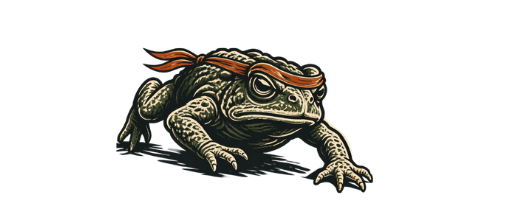
So, as Guernsey was ahead of us Jersey folk and brought in the Donkey Drop Out, it seemed the right thing to do and keep our friendly rivalry alive. Guernsey residents are known as Donkeys and Jersey folk, Crapauds or toads. In Jersey we have resident and native toads or in the Patois "crapauds".We are also sometimes known as Beans...but they are just not built for Backyard Ultras!
Who is the Winner?
The last one standing! When the race gets down to two runners, whoever drops, leaves the victor.
How far do we have to run and how long does it run for?
That is the whole point...we just do not know! We know that each lap is 4.167 miles and each yard has a one hour cut off (on the hour, not your stopwatch) but who knows who will keep on trotting. For example Australian ultra-runner Phil Gore set the men's backyard ultra world record at the Dead Cow Gully event in Queensland, Australia, completing 119 consecutive 6.7 km (4.167 mi) laps, totaling 495.87 miles (798 km) on 26 June 2025. Whilst, The women's backyard ultra world record is held by Sarah Perry, who completed 95 laps (395.8 miles / 637 km) at Big's Backyard Ultra Individual World Championship in Tennessee in October 2025.
This does not answer your question! As long as you can keep running and complete the yard before the hour bell sounds or owl hoot or conch shell or didgeridoo sounds you can keep going.
Will there be a night route?
We are currently finalising the route design and are looking at a night route...this will be confirmed.
Is this only for fast runners?
Ok, lets not pretend this is an easy race, its not! However, depending on your way of thinking this can be a really sociable run. The runners will be returning to the base every hour where there will be an atmosphere of gloom and desolation! Runners will start every yard together, so a real opportunity to run together and chat about footwear and chaffing! However, you do not have to be fast. In truth, the fastest runners often drop our early as it is about consistency and tactics not pure speed.
When do I rest, eat and sleep?
That all depends on how much time is left on the completion of the last yard, as the next yard will begin on the hour. If you complete the yard in 45 minutes you have 15 minutes to rest, eat and sleep...not much time! You could eat whilst you run, drink on the trot. The choice is yours.e
Is the route on trail or tarmac?
The route will most definitely be trail. The route that is being worked on up at Les Landes is 100% on trail, with no road crossings. Routes below.
Is it flat?
All in all, this is a flat route by Jersey standards! The current route is looking at an elevation gain of around 85 metres over for each yard and a similar drop. So, around 2,039 metres climbing over 100 miles - not to be sniffed at but certainly not to be grimaced at!
To put into context and to compare against some 100 milers - UTMB is around 10,040 metres, Western States 5,513 metres, Ronda del Cim 13,500 metres. Local context, let's compare with Round The Rock which is approximately 1300 metres over the 48 miles.
So, this is just a crawl around the yard!
What facilities will be on offer?
The event will be centred on a race area where there will be parking, toilets, showers and space to set up a camp for you and your crew. Water will be provided and you will need to bring cups / bottles.
Depending on the numbers and whether a sponsor is mad enough to come on board we may manage to bring in some food supplies and even a marquee. We would like to create a trail festival atmosphere as this will be an event that may last for days and days... but at this stage we are rough and ready - backyard style!
Will the route be marked?
The route will be fully marked with reflective tape.
Will there be marshals?
There will be marshals who will appear at random times in random places to check on the course. The nature of the route does not require full marshal presence except at race central.
How will organisers check that people keep to the route?
There will be some clever checks out on the course as well as random pop - up marshals. Runners will need to have a watch with a GPS facility so routes can be checked if there is reasonable doubt.
What will happen if runners find and use a short cut?
There will be an automatic penalty of 15 minutes if it is clearly intentional short cutting. Errors that are clearly accidental will be with the Director for a decision.
Can we have pacers and support on the course?
We ask that all support is kept to the race base. Pacers are not allowed.
How many finishers will there be?
Only one, the winner! All other runners will be recorded as DNF (Did not Finish) - Brutal! You will still earn your bragging rights and can share your story but there can only be one last Crapaud Crawling!
Will we get any bling?
All runners will receive a stunning "Crapaud" T Shirt that meets our eco standards and a commemorative finishers medal type thing!! There will be prizes.
Can we use donkeys or bicycles?
Absolutely not, but camels, crocodiles, cayman, capybaras and crapauds are all acceptable modes of transport.
Will the route be floodlit?
If you are asking that question...you are not the right toad for the race! You will need torches whether head, hand held or body worn. Flaming oil torches or burning branches will be prohibited...
Why should we bother?
Excellent question and when I have the answer I will let you know...
Do I need to enter now, its only 2026?
Numbers will be limited and we expect a level of interest. Backyard ultras are popular...you have been warned.
Are there age restrictions?
As you will appreciate this race can become "extreme" but for many and for most it is in reality a safe event. You will never be more than 500 metres from the base and you will be back to the race area every hour. So, in reality it is safe and you will drop when you can crawl no more! The full backyard, 24 hours and 12 hours will maintain a strict 18 and over age limit. For the 16 hour event the age is reduced to 16 with parental permission and parental presence during the event.
What are the refund policies?
If Run Jersey Events changes the event and you cannot run, a 100% refund will be offered or a full deferral offered for the following year.
100% refund for cancellations before 31st December 2026.
50% refunds for cancellations from 1st January 2027 - 31st July 2027.
No refunds will be offered for cancellations from 1st August 2027.
Deferrals will be available.
We would recommend you use the race protection offered through Race Nation when registering.
"If you're going to face a challenge, it has to be a real challenge. You can't accomplish anything without the possibility of failure."
Laz
So, now I am convinced but how do I enter?
Click the Crapaud below to register...
Click Running Man to view registered runners...

Backyard Rules
(Lazarus Lake's Official Rules)
Course
Loop or out and back
Must be 4 miles 880 feet in length
Metric equivalent 6.7056 kilometers
Starting Corral
Measured to fit entire starting field
Corral stays the same size throughout the event
Participants must be inside the corral at the bell
Starts
Each Yard starts precisely one hour after the last
Warning must be given 3, 2, and 1 minute before the bell
All competitors must start at the bell (No late starts)
Yards
Except for restroom breaks a competitor cannot leave the course until the Yard is complete
No non-competitors may accompany active entrants on the course (including eliminated runners)
No personal aid during a Yard
Each Yard must be completed in less than an hour to be counted
No artificial aids (including trekking poles)
Slower runners must yield/allow passes
Timing
Keeping lap times is optional
Winner/Results
The winner is the last person to complete a Yard
All others are technically DNF
Results of each participant in terms of Yards completed are to be given
If no participant can complete one more yard than anyone else, there is no winner.
Cap
Race must be open ended
Backyard 24 Rules
Backyard Races with a defined finish up to 24 hours may be held
These races are named according to their length (Backyard 6 for 6 hours, etc)
No winner is named. Participants either finish or DNF
All other Backyard Rules apply.
If a Backyard 24 is held in conjunction with a Backyard Ultra all participants of both events must start at the same time.
Click the Crapaud to enter and get crawling!
One More Loop: The Relentless Rise of the Backyard Ultra
Ultra Running Magazine
Shalini Bhajjan 05/14/2026
Gary Cantrell (better known to the ultrarunning world as “Lazarus Lake”) once imagined a race with no finish line, and the idea came from his days in high school track when running 4 miles an hour was the only way he could outlast the fastest runner on the team. Decades later, that concept found its purpose. Tennessee’s Greenbelt tax program required him to keep his own 150 acres as an open‑space or conservation forest to maintain affordable property taxes. Rather than log or develop the land, he created a recurring event on his property: a simple looped race named after his dog, Big. That race, Big Dog’s Backyard Ultra, fulfilled the Greenbelt use requirement, preserved the land exactly as he intended, paid the taxes and ultimately grew into one of the most iconic endurance events in the world.
From Cantrell’s humble backyard in Tennessee, the format has exploded into one of the most influential movements in modern ultrarunning. Backyard Ultras now appear in small towns and major cities all over the world and are designated as national championships and international team competitions. Cantrell recently recalled that participation doubled in 2020, and today, there are roughly 700 affiliated Backyard Ultras and another 700 unaffiliated events across more than 85 countries.
But the questions remain: why has this format captured the imagination of runners everywhere? And what makes a Backyard Ultra so different from the traditional ultras that built the sport?
Part of the appeal lies in its simplicity: run 4.167 miles every hour, on the hour, until only one runner is standing. It’s a format that gives average runners a legitimate shot at running a sub‑24‑hour 100‑miler, and one where the fastest athletes can’t simply outrun the field. Everyone starts together every hour. Everyone resets. Everyone depends on each other to keep the race alive. It’s a format that brings runners together and, eventually, tears them apart. In a Backyard Ultra, you are never behind – you are only one loop away from being right back in the race.
As the race director of St. Louis’s only Backyard‑style event, the Queeny Backyard Ultra, I’ve seen firsthand how this format becomes the great equalizer. In my 12 years of directing ultramarathons, nowhere have I seen a more diverse field of runners, each arriving with a personal goal or a distance PR in mind, all with the same chance to continue or to quit. The Backyard format gives every runner the same hour, the same loop and the same opportunity to surprise themselves.
Traditional ultras and Backyard Ultras test runners in fundamentally different ways with ultramarathons being a journey including fixed distances, defined finish lines and a narrative arc with a beginning, middle and end. Backyard Ultras, by contrast, are psychological chess matches. There is no known distance, no finish line and no continuous rhythm – only micro‑recovery, the relentless toll of the hourly bell and the question that grows heavier with each loop: can I do one more?
Cantrell often says the format reveals something deeper than fitness, exposing patience, stubbornness and the ability to negotiate with your own mind. The Backyard Ultra isn’t about who’s fastest – it’s about those who can endure the longest conversation with their own doubt. Four miles in an hour feels wildly accessible, yet the challenge becomes endlessly daring. Between loops, runners gather to eat, laugh, swap stories and quickly push each other back to the corral, forming a tight‑knit crew of co‑survivors. And unlike traditional ultras with a fixed endpoint, the Backyard offers the thrilling unknown of how far you can go if you simply refuse to stop. For spectators, it’s pure adrenaline – every hour resets the race, every loop is a fresh twist and the suspense builds until only one runner is left standing.
Cantrell has always had a knack for designing races that test the edges of human capability. The Barkley Marathons is infamous for its near‑impossible finish rate, but the Backyard Ultra is different. It isn’t designed to break runners – it’s designed to reveal them. The rise of the format reflects a cultural shift in ultrarunning: athletes aren’t just chasing distances anymore; they’re chasing experiences that challenge identity, ego and resilience. As Cantrell puts it, “The Backyard is fair. Everyone gets the same chance, the same loop and the same hour. What you do with it is up to you.”
From Big Dog’s Backyard Ultra to local grassroots events, the format has become a global phenomenon. National championships, world team competitions and record‑setting performances have cemented the Backyard Ultra as a legitimate and uniquely compelling discipline within the sport. Traditional ultras remain the backbone of the community, but this format has carved out a new space, offering something both familiar and radically different.
In a sport built on pushing limits runners are being asked to push a different one: the limit of showing up, over and over, long after the finish line has disappeared. In a world obsessed with finish lines, the Backyard Ultra offers something radical: a race where the finish is unknown, the challenge is internal and the victory belongs to the last person willing to answer the bell.